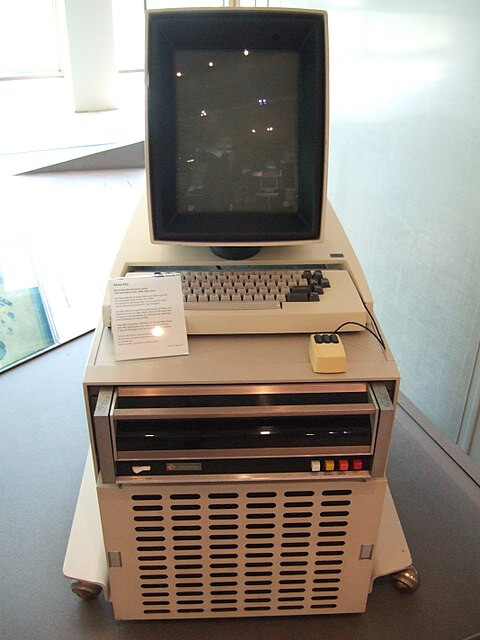
Xerox Alto
The computer is a Xerox Alto, developed at Xerox PARC beginning in 1973.
| Specification | Xerox Alto |
|---|---|
| Introduced | 1973 |
| Display resolution | 606 × 808 pixels |
| Orientation | Portrait |
| Display | 1-bit monochrome bitmap |
| Screen size | ~8 × 10 inches |
| Typical RAM | 128 KB initially |
| Local disk | 2.5 MB removable cartridge |
| Networking | 3 Mbps Ethernet |
| Input | Keyboard, 3-button mouse, 5-key chord keyboard |
Operating System
The Alto ran the Alto Operating System, with the Alto Executive (“Exec”) serving as its command environment.
It wasn’t quite a modern GUI operating system with one persistent desktop and multiple applications. Applications generally took control of the bitmapped display themselves.
Important Alto software included:
- Bravo — pioneering WYSIWYG word processor
- Smalltalk — graphical, object-oriented programming environment
- Draw — graphics program
- Laurel — graphical email
- Mesa and BCPL development environments
- Ethernet-based file and printing services
The Display
The Alto’s display resolution was:
606 × 808 pixels
This was a true bitmapped framebuffer. Individual pixels were represented in memory rather than the display being a conventional character terminal.
The unusual portrait orientation was deliberate: the screen approximated the shape of a sheet of paper. This was particularly useful for WYSIWYG document editing.
Why the Alto Matters
The remarkable thing is the date: 1973.
The Alto already demonstrated many concepts that would define personal computing:
- Bitmapped graphics
- Mouse input
- Graphical user interfaces
- Windows and menus
- WYSIWYG document editing
- Ethernet networking
- Network file servers
- Network printing
- Graphical email
- Object-oriented graphical programming
This was four years before the Apple II and eight years before the IBM PC.
The Alto also belongs directly to the technological lineage that eventually produced Xerox’s Lisp machines and Interlisp-D/Medley:
Xerox Alto → PARC Lisp research → D-machines (Dorado/Dandelion/etc.) → Interlisp-D → Medley